Posts

Showing posts with the label CO2

Two years...

... Two years! Wow, the time flies! I've picked up some new wireless tag sensors that can plug in to a USB wall plug and will use fewer button batteries. I am still working to get all those placed, but I've got one in the uninsulated detached garage and one in the study again. I am probably overdue to explain the gradual changes to the monitoring system, but that is not this post. I did a day of calibration (August 11th) where I pulled all the sensors and put them in one place so that I could make sure that they all had the same sense of temperature and humidity. They were all fairly close, but I tweaked individual sensor calibrations by up to ~0.3 °C for some sensors. The Netatmo CO₂ sensors were fairly far out since they recalibrate to 400ppm based on the assumption that CO₂ levels drop to 400ppm at least once a week. Normally that would not be an issue, but lockdown. Yes, one of the lesser appreciated impacts from the lockdown is that my CO₂ sensors were u...
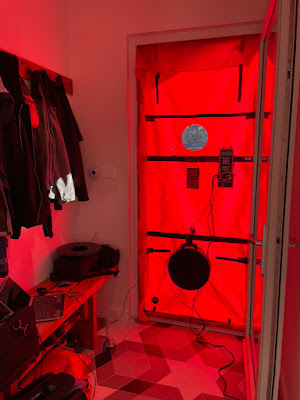
Air tightness....

Image
I get a reasonable number of questions about air tightness which is one of the key passive house principles. Australia has no air tightness requirements...  despite some solid suggestions  and some solid International examples . The UK requires new houses to have < 10 ACH50. The USA Department of Energy has a Zero Energy Ready Home national program certification that outlines required ACH50 values ranging from 1.5 to 3 depending on climate zone. Certified Passive Houses are required to have < 0.6 ACH50. Air tightness is measured using a blower door test. Using a calibrated fan and pressure gauges they increase and decrease the pressure in the house relative to outside measuring how much air has to be pumped in or out to maintain the desired pressure at a range of pressures. From these measurements they determine how much air leaks in when the house is 50Pa lower than outside and how much air leaks out when the house is 50Pa higher than outside. To account for the fact t...

IEA - 2050 Report

 The International Energy Agency is not known as a hot bed of tree huggers. It has been one of the oft quoted sources of the Australian Liberal (they are conservative) Party's thoughts about energy policy... but they have dropped a new report outlining the viable pathway to net zero emissions by 2050 . It is a huge document with lots of stuff in it, and I am not an expert in these things... but I consider myself a reasonably sensible and intelligent person... and interested in the future of the human species. So in the context of this blog I wanted to highlight a few things it mentions in terms of our built environment. By 2030 - all new buildings need to be zero-carbon-ready . That is quite soon! I would be curious as to our current level, but it is almost certainly a very small proportion and not increasing fast enough to meet this target. By 2040 - 50% of existing buildings need to be retrofitted to zero-carbon-ready levels .  "Around 2.5% of existing residential build...

Night Ventilation...

One of the keys to passive house is air tightness and mechanical heat recovery ventilation... which is great most of the time time. But during hot days and cool nights it is often beneficial to get as much night time cooling (i.e., ventilation) as possible - which means opening the windows. In our passive house the primary thermal mass is the water wall, and the house is designed to allow for efficient night ventilation of the house and water wall by opening two panels of the big north facing window near the water wall and the clerestory windows at the top of house. This creates a ' stack effect ' with the hot air rising out the top of the house helping to pull cool air in the house at the bottom... across the water tanks in the process. Last night was the first time we opened the windows to allow this night time cooling to happen (as today's weather was forecast to be very warm we wanted to cool down the house as much as possible before hand). While I'll work on a ...

Carbon Dioxide and HRV

Image
The things one learns about ventilation... Our heat recovery system is set to by default to replace 1/3 of the house air volume every hour, and we have nifty little Netatmo sensors that measure carbon dioxide (amongst other things). I say 33% of the volume by default because the bathroom and kitchen contain booster switches that increase the replacement to 50% for 30 minutes - designed to clear the effects of cooking, showering, and other such activities.  Here I've attached a "normal day" from last week. It is fairly clear when the parents leave their bedroom to start their day, when we get home, and when we go to bed. In comparison our old house, had no mechanical ventilation but did leak like a sieve. The carbon dioxide levels in the living room of the old house would routinely get above 2000ppm, and quite often didn't quite get back to 400ppm before we came home from work/school unless the windows were left open. In the new house carbon dioxide levels ...