Posts

Showing posts with the label ramblings

Solar part 3 (upgrade 2)

We have completed the 2nd upgrade to our power system. Our original solar system has: Longi Solar Half Cut Modules (14 x 375W = 5.25kW DC) Degradation profile: < 2% first year,  0.55% years 2-25. Efficiency: 19.5% with Enphase IQ7+ Microinverters (14 x 295W = 4.130 kW AC) Then we added batteries about a year ago: Enphase IQ Battery 5P  (2 x 5kWh = 10 kWh) Now we have topped up the solar system (in preparation for a future EV and to make us net positive in generation across the full year) with: AIKO Solar Neostar 2S (12 × 510W = 6.12kW DC) Degradation profile: < 1% first year,  0.35% years 2-30. Efficiency: 23% with Enphase IQ9 Microinverters (12 x 427W = 5.124kW AC) Enphase IQ Battery 5P (2 x 5kWh = 10 kWh) There are some technicalities in there including both the DC and AC sizing of the two solar arrays. The original panels are on the house roof and tilted 20° towards the sun, whereas the new panels are on the garage roof and tilted 7° away from the sun. This ...

Sustainable house day 2026

Image
We had about a dozen or so people through for Sustainable House Day 2026 . Always a great day with lots of conversations with very interesting people. A couple different people asked about house performance relative to the PassivHaus design spec: Temperature performance (based on just over 6 years of data): Keep in mind that we aim for 18 - 25 °C rather than 20 - 25 °C. At the hot end, we have experience 1.1% of hours above 25 °C. Indoor, our maximum recorded temperature was 26.6 °C, and in comparison the outside max was 42 °C. I would translate as... 26°C inside feels really nice when it is 42 °C outside. Less than 0.03% of hours have a temperature < 18 °C, and 5.6% of hours have been between 18 and 25 °C.  Energy Use : Again over the same timeframe (minus a few months with some data issues associated with reconfiguring the system for batteries). Mean energy usage is 13.3kWh per day. Mean production is 13.0kWh per day, with half of our energy use being met by onsite product...

Batteries

Image
We did it. It is not clear that the batteries will save us money, although with the way electrical prices are going, they might, and it isn't clear that they won't save us money either. At some point, we wanted to be part of the solution, so the likely breakeven-ish economics were good enough. Call it an investment in the future stability and sustainability of the Australian electricity grid. In terms of economics. Relative to my last statement on the topic, back in 2021 , four years is a long time. Batteries have gotten better, the cost of electricity is up (and demand pricing has arrived), solar feed-in tariffs are down, and NSW has a battery rebate at the moment. The cost of electricity has become increasingly complicated, making modeling costs/savings more tedious as the costs vary by time of day with times of day changing seasonally. Which also means there are more ways that electricity costs will likely change in the future. Minimally, with the battery system, we shou...

Five year retrospective

Image
Every so often I find myself chatting with someone about the performance of the house and I am caught out with not actually having looked at the numbers except on a month-by-month basis. So here is a bit of a look at 5 years of data. March 2020 - February 2025. Hard to believe that we have been living here for over 5 years, but we have been (actually longer than that, but the data are consistent back to mid-February 2020). For the record, I am using data spanning the 1st of March 2020 through 28th of February 2025. A few things of note. In winter months, we aim for a house temperature at or above 18 °C inline with the WHO recommendations and a general happiness with sleeping / waking up to a house that is ~ 18 °C. Using the hourly averages, the outside temperature ranged from 0.2 to 42.4 °C with a median temperature of 17.1 °C. The inside temperature ranged from 17.6 to 26.6 °C with a median temperature of 22.2 °C. Over the past 5 years, we have been in the passivhaus temperature t...

A new sensor...

I'ver splashed out and picked up a pair of Purple Air Flex air quality monitors. These sensors measure temperature, humidity, pressure, PM2.5 concentrations, and total volatile organic compounds (VOC). (The VOC readings are currently experimental.) The sensor outside data are publically viewable on the purple air map , but the inside sensor data is not disclosed in real time. I will however be doing some experiments with it. One of these days I'll find the ideal sensor package, but until then I just keep collecting!

Bees...

Image
Australia has endemic stingless bees... and now we have some in our yard.  Tetragonula carbonaria are not the European Honey Bees that most people know... they are much smaller and don't have stingers. In the Sydney region, T. carbonaria is at the southern end of its range as they only forage for food at temperatures above 18 °C. Keen observers of this blog will know that for a reasonable period of the year we experience outdoor temperatures below 18 °C. They also do not like temperatures above 38 °C. Outdoor temperature from August 2018 through the end of 2022. You can see that we had a few days in January 2020 that would have been too hot for the bees.  Outdoor temperature from August 2018 through December 2022. The green zone (18 - 38 °C) are temperatures at which the bees will forage. They will have very high mortality at temperatures below 0 °C or above 42 °C. Bees returning to the hive after visiting flowers... The entry to the hive box is through a ...

Two years...

... Two years! Wow, the time flies! I've picked up some new wireless tag sensors that can plug in to a USB wall plug and will use fewer button batteries. I am still working to get all those placed, but I've got one in the uninsulated detached garage and one in the study again. I am probably overdue to explain the gradual changes to the monitoring system, but that is not this post. I did a day of calibration (August 11th) where I pulled all the sensors and put them in one place so that I could make sure that they all had the same sense of temperature and humidity. They were all fairly close, but I tweaked individual sensor calibrations by up to ~0.3 °C for some sensors. The Netatmo CO₂ sensors were fairly far out since they recalibrate to 400ppm based on the assumption that CO₂ levels drop to 400ppm at least once a week. Normally that would not be an issue, but lockdown. Yes, one of the lesser appreciated impacts from the lockdown is that my CO₂ sensors were u...

Second guessing ERV

Image
I've been a bit busy lately, so I've not had a chance to run the formal numbers... and there are a lot of variables at play, but... My partner and I have noticed that the house is a lot drier this winter than it was last winter when we were alternating the HRV and ERV cores. A glance at the data suggests that the ERV does what it is supposed to do and helps keep moisture in the house during the winter heating period. I am planning to have a look at the moisture levels in the house between the ERV and HRV periods. I've attached a summary plot from the our system which does hit at what I am talking about... Compare the May / June period from 2020 and 2021. Just peeking at the graph it looks like the ERV maintains a much higher humidity (but still in the good range) than the HRV core with supply values ~ 10g/Kg for the ERV core versus 6-7g/Kg for the HRV core. In the most comparable time last year we were not at home 100% of the time like we have been this year. So maybe a hu...

Air tightness....

Image
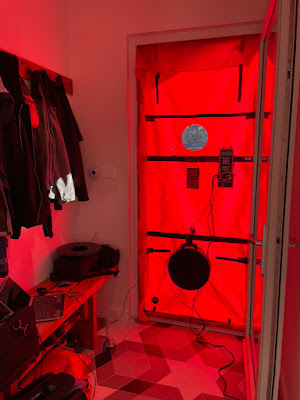
I get a reasonable number of questions about air tightness which is one of the key passive house principles. Australia has no air tightness requirements...  despite some solid suggestions  and some solid International examples . The UK requires new houses to have < 10 ACH50. The USA Department of Energy has a Zero Energy Ready Home national program certification that outlines required ACH50 values ranging from 1.5 to 3 depending on climate zone. Certified Passive Houses are required to have < 0.6 ACH50. Air tightness is measured using a blower door test. Using a calibrated fan and pressure gauges they increase and decrease the pressure in the house relative to outside measuring how much air has to be pumped in or out to maintain the desired pressure at a range of pressures. From these measurements they determine how much air leaks in when the house is 50Pa lower than outside and how much air leaks out when the house is 50Pa higher than outside. To account for the fact t...

The old house... and some musings on energy usage.

Image
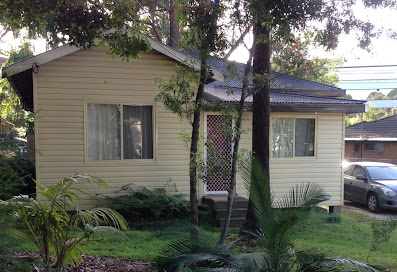
In response to the recent posts on temperature and carbon dioxide in the old house some have asked if it was in fact a tent... so I thought I would share some information on our old house. It was a lot like many of the houses that still exist in Thornleigh. I don't know the year it was built, but it was probably built between WWI and WWII, but had been gutted and renovated circa 1994 (based on the manufacture date printed back of the dry wall).  Originally it would have been two large front rooms and two smaller rooms in the rear with a central hallway plus a front and back porch. Very soon after construction an additional large room was added on the north side of the hallway (as we took the old house down you could see where the window had been). Both porches were filled in and the floors raised to the level of the house during the renovations. The floor plan consisted of 3 bedrooms, a living room, a kitchen/eating area, a bathroom, a laundry closet and a hallway. The total floo...

Carbon dioxide (Old vs. New)

Image
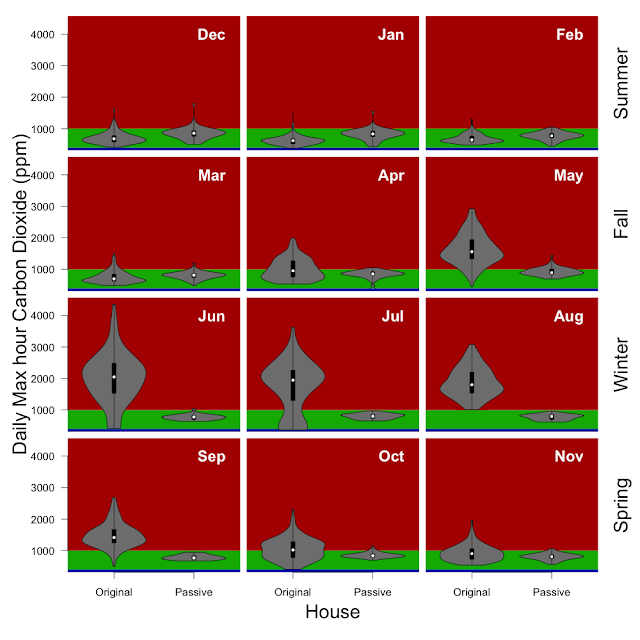
I one of the things I've noticed is the carbon dioxide levels in our passive house compared to our old house which had plenty of draughts but no ventilation aside from a bathroom exhaust fan.  So I've used the NetAtmo carbon dioxide data collected every 5 minutes since October 2012 to quantifiy the differences.  I only have a single sensor located in the respective living room of each house.  I averaged the raw measurements to get hourly averages.  Because I most interested in peak carbon dioxide - I've taken the maximum hourly average for each day. This ends up being 2,192 days from the original house, 615 days from the passive house. I've left the rental house out of this comparison, but it was disturbing like the original house despite being ~ 20 years old. By way of standards: 420ppm is typical CO2 level outside, less than ~ 1000ppm is considered to be good, levels greater than 2000ppm are often associated with headaches and drowsiness. The key take-home mes...

Temperature (Out vs. Old vs. New)

Image
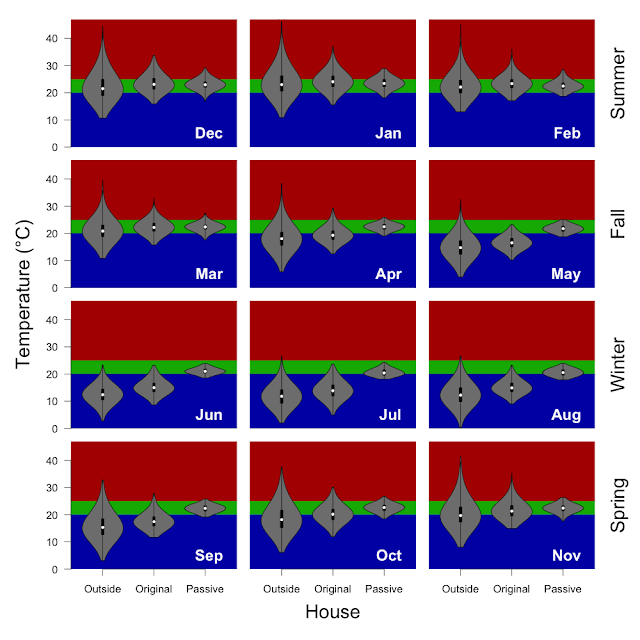
I have fielded more than a few questions about the temperature of our passive house versus the temperature of the house that we lived in prior (on the same lot).  So I've used the data I had on hand which is temperature (°C) recorded every 5 minutes over since October 2012. For the sake of consistency I am only using the NetAtmo sensors that I have had for that entire period. So I only have one outside sensor and one inside sensor located in the the respective living room. The outside sensor moved around a bit, but it should be good enough.  I've converted those measurements to hourly averages.  This ends up being ~ 66,955 hours to play with (52,232 hours from the original house, 14,723 hours from the passive house). I've left the rental house out of this comparison, but it was disturbing like the original house despite being ~ 20 years old. The key take-home messages: The passive house a much less variation in temperature than the original house (or outside).  ...

IEA - 2050 Report

 The International Energy Agency is not known as a hot bed of tree huggers. It has been one of the oft quoted sources of the Australian Liberal (they are conservative) Party's thoughts about energy policy... but they have dropped a new report outlining the viable pathway to net zero emissions by 2050 . It is a huge document with lots of stuff in it, and I am not an expert in these things... but I consider myself a reasonably sensible and intelligent person... and interested in the future of the human species. So in the context of this blog I wanted to highlight a few things it mentions in terms of our built environment. By 2030 - all new buildings need to be zero-carbon-ready . That is quite soon! I would be curious as to our current level, but it is almost certainly a very small proportion and not increasing fast enough to meet this target. By 2040 - 50% of existing buildings need to be retrofitted to zero-carbon-ready levels .  "Around 2.5% of existing residential build...

FAQ on building and living in a certified passivhaus...

I went to the Australian Passivhaus Association sponsored open house at Asquith Passivehaus  on Friday and it was great fun to catch up with about a hundred people into passive houses.  At these gatherings if people discover that I live in a passivhaus then they always ask about the money and the stress associated with choosing to build a certified passivhaus. Stress associated with the decision to build a certified passivhaus: Deciding to build a house is a big decision. The choice to build a passive house was the least stressful or difficult choice we made when building our new home. It doesn't dictate a particular style for the house - it is about meeting an efficiency standard - which can stress out your architect and builder, but the the owner! Deciding to build a certified passive house made the process less stressful because of the added certainty of how our new house would perform was so much less... someone with far more knowledge than I possess was going t...

Solar...

As of February the solar is finally installed and working as it should have been back in August. It was a major drama to get the solar panels installed due to the SIP roofing. Apparently most solar installs involve driving bolts through the roof into the building frame... But we don't have a building frame, the SIP is our air tight layer, not to mention we don't want a bunch of thermal bridges. It took contracts with two different companies (not being a standard install was too much for most companies contacted about the installation), and eventually it took two install attempts by the second company when the first bracket they tried did not fit as required. The very big tree that shades our roof made it a bit hard to predict the generation capacity, but our 5.22kW system is generating power that would be expected from an unshaded ~ 4kW system (~ 17kWh / day). Which more than offsets our typical consumption ~ 7kWh / day. Once we have enough data I'll post a more detailed ...