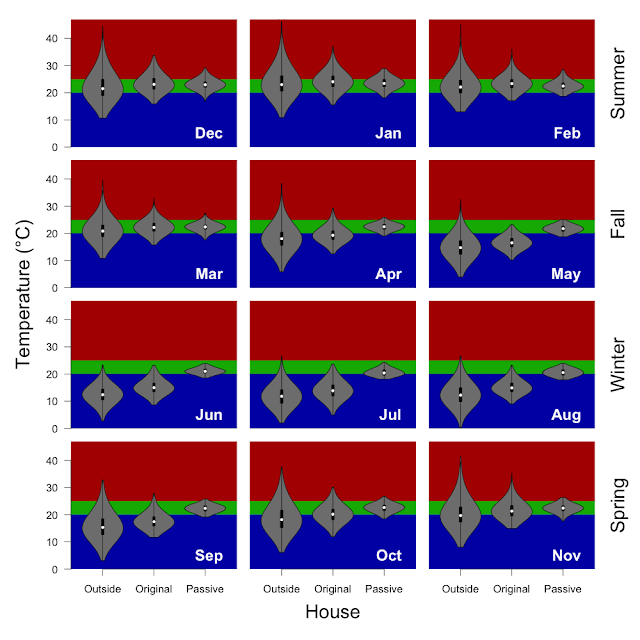
I have fielded more than a few questions about the temperature of our passive house versus the temperature of the house that we lived in prior (on the same lot). So I've used the data I had on hand which is temperature (°C) recorded every 5 minutes over since October 2012. For the sake of consistency I am only using the NetAtmo sensors that I have had for that entire period. So I only have one outside sensor and one inside sensor located in the the respective living room. The outside sensor moved around a bit, but it should be good enough. I've converted those measurements to hourly averages. This ends up being ~ 66,955 hours to play with (52,232 hours from the original house, 14,723 hours from the passive house). I've left the rental house out of this comparison, but it was disturbing like the original house despite being ~ 20 years old. The key take-home messages: The passive house a much less variation in temperature than the original house (or outside). ...
Every so often I find myself chatting with someone about the performance of the house and I am caught out with not actually having looked at the numbers except on a month-by-month basis. So here is a bit of a look at 5 years of data. March 2020 - February 2025. Hard to believe that we have been living here for over 5 years, but we have been (actually longer than that, but the data are consistent back to mid-February 2020). For the record, I am using data spanning the 1st of March 2020 through 28th of February 2025. A few things of note. In winter months, we aim for a house temperature at or above 18 °C inline with the WHO recommendations and a general happiness with sleeping / waking up to a house that is ~ 18 °C. Using the hourly averages, the outside temperature ranged from 0.2 to 42.4 °C with a median temperature of 17.1 °C. The inside temperature ranged from 17.6 to 26.6 °C with a median temperature of 22.2 °C. Over the past 5 years, we have been in the passivhaus temperature t...
June was decidely wintery (median temperature 11 °C). Outside temperatures ranged from 2 to 21 °C, while inside we were a comfortable 19 to 23 °C. The HRV was in the heating season and the split system was set to heat to 20 °C. Now that we have solar house batteries we no longer need to schedule the split system to run during solar generation as we have done prevously. Temperature from inside and outside the house as the percentage of hours in 0.5 °C bins. I've scaled the temperature in hope that I will be able to use the temperature range for all months. Methods: I have taken the 5 minutely data from the wirelessTag sensors and calculated the median temperature for each hour and determined the proportion of hours falling inside of the 20 - 25 °C target temperature (using the R functions 'aggregate' and 'hist'). Inside includes data from the wirelessTag sensors spread across nearly every room of the house. Outside is the data from the wirelessTag sensors outs...