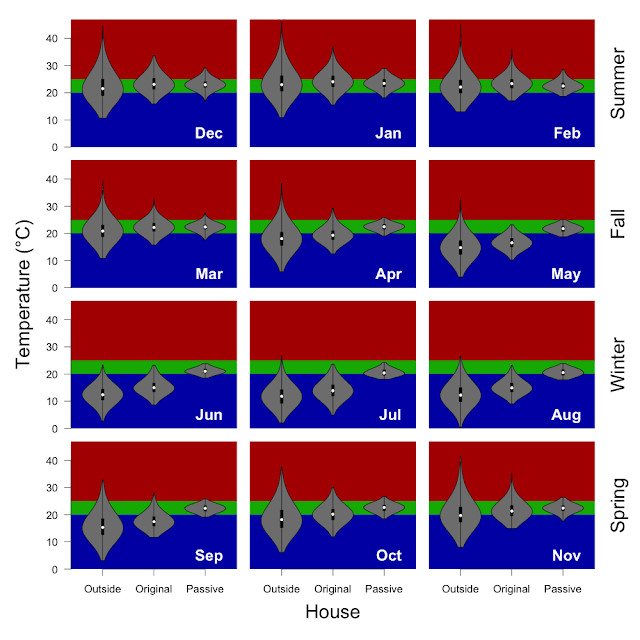
I have fielded more than a few questions about the temperature of our passive house versus the temperature of the house that we lived in prior (on the same lot). So I've used the data I had on hand which is temperature (°C) recorded every 5 minutes over since October 2012. For the sake of consistency I am only using the NetAtmo sensors that I have had for that entire period. So I only have one outside sensor and one inside sensor located in the the respective living room. The outside sensor moved around a bit, but it should be good enough. I've converted those measurements to hourly averages. This ends up being ~ 66,955 hours to play with (52,232 hours from the original house, 14,723 hours from the passive house). I've left the rental house out of this comparison, but it was disturbing like the original house despite being ~ 20 years old. The key take-home messages: The passive house a much less variation in temperature than the original house (or outside). ...
Every so often I find myself chatting with someone about the performance of the house and I am caught out with not actually having looked at the numbers except on a month-by-month basis. So here is a bit of a look at 5 years of data. March 2020 - February 2025. Hard to believe that we have been living here for over 5 years, but we have been (actually longer than that, but the data are consistent back to mid-February 2020). For the record, I am using data spanning the 1st of March 2020 through 28th of February 2025. A few things of note. In winter months, we aim for a house temperature at or above 18 °C inline with the WHO recommendations and a general happiness with sleeping / waking up to a house that is ~ 18 °C. Using the hourly averages, the outside temperature ranged from 0.2 to 42.4 °C with a median temperature of 17.1 °C. The inside temperature ranged from 17.6 to 26.6 °C with a median temperature of 22.2 °C. Over the past 5 years, we have been in the passivhaus temperature t...
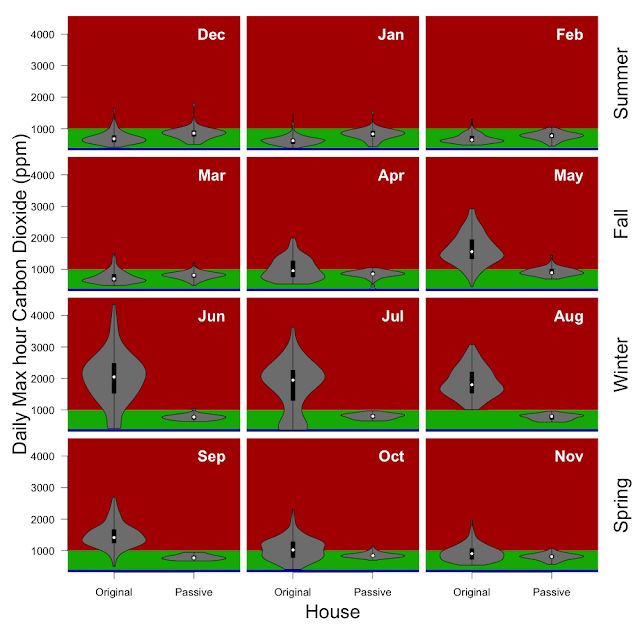
I one of the things I've noticed is the carbon dioxide levels in our passive house compared to our old house which had plenty of draughts but no ventilation aside from a bathroom exhaust fan. So I've used the NetAtmo carbon dioxide data collected every 5 minutes since October 2012 to quantifiy the differences. I only have a single sensor located in the respective living room of each house. I averaged the raw measurements to get hourly averages. Because I most interested in peak carbon dioxide - I've taken the maximum hourly average for each day. This ends up being 2,192 days from the original house, 615 days from the passive house. I've left the rental house out of this comparison, but it was disturbing like the original house despite being ~ 20 years old. By way of standards: 420ppm is typical CO2 level outside, less than ~ 1000ppm is considered to be good, levels greater than 2000ppm are often associated with headaches and drowsiness. The key take-home mes...